Category: Books

  • Deciphering the Illegible

    Macuch, Maria & Arash Zeini (eds.). 2024. Deciphering the illegible: Festschrift in honour of Dieter Weber (Iranica 33). Wiesbaden: Harrassowitz Verlag.

    The commemorative publication Deciphering the Illegible is dedicated to Dieter Weber, one of the most important scholars in the field of Iranian Studies, who is best known for his work on deciphering original documents in the extremely ambiguous Pahlavi cursive script, which was long considered ‘illegible’. In addition to an appreciation of his research and a bibliography of his publications, the volume contains twenty-eight contributions by renowned experts, reflecting the broad spectrum of the dedicatee’s academic interests and research work. The articles cover a wide range of topics and offer many new insights and original perspectives on religious, linguistic and historical problems, including several editions of previously unpublished texts.

    Abstract

    Table of Contents

    • Dieter Weber — A Scholarly Profile
    • Publications of Dieter Weber . . . . . . . . . . . . . . . . . . . . . . . . .
    • Miguel Ángel Andrés-Toledo: Three Zoroastrian Manuscripts in Armenia
    • Thomas Benfey: Windādag’s Orders: Ten Unpublished Middle Persian Ostracafrom Chāl Ṭarkhān-ʿEshqābād
    • Adam Benkato: A Manichaean Remedy for Headaches
    • Alberto Cantera: The Passive Suffix -ī̆h̆– in Middle Persian
    • Carlo G. Cereti: From the Zamyād Yašt to the Seventh Book of the Dēnkard, Some Notes on Sistan and Zoroastrian Eschatology
    • Iris Colditz: How to Make Clarified Butter in Sogdian
    • Touraj Daryaee: The Owl in the Zoroastrian Tradition: Contribution to Iranian Bestiary I
    • Desmond Durkin-Meisterernst: Hübschmann and the Middle Iranian Part on Armenian Loanwords
    • Shervin Farridnejad and Arash Zeini: “Who Will Protect the Cattle”? On Dogs and the Sin of Meat Consumption in Zoroastrianism
    • Ela Filippone: A Contribution to Pahlavi Lexicography: The Case of ⟨twk(‘)⟩ and ⟨twp(‘)⟩ in the Pahlavi Corpus and their Possible Cognates in Modern Iranian Languages
    • Philippe Gignoux †: Sur l’argenterie sassanide, relectures et nouveautés
    • Rika Gyselen: Le y final et le trait final en moyen-perse: le cas des sceaux des administrations territoriales
    • Almut Hintze: The Pahlavi Psalter in its Historical Context
    • Philip Huyse: Klimawandel und die spätantike Pest im sasanidischen Reich
    • Götz König: Notizen zur Überlieferung und zum Gebrauch der Yašts
    • Pavel B. Lurje and Boris Zheleznyakov: “Let Buyruq Sangun Live Long and be Divinely Blessed” Another Sogdian Dedicatory Inscription
    • Maria Macuch: Trading with Infidels: A Balancing Act in Zoroastrian Legal Reasoning
    • Mauro Maggi: Blowing out saṃsāra in Khotan.
    • Jaime Martínez Porro: A Brief Note on an Avestan Quotation in the Wizī̆rgerd ī̆ Dēnī̆g
    • Enrico Morano: Fragments from a Sogdian Cosmogonical Manuscript in Manichaean Script.
    • Antonio Panaino: The ‘starred’ Frawahr and the ‘Katasterization’ of Humanity
    • Anna-Grethe Rischel: Studies of ‘Watermarks of Technology’ from the Turfan Collection in Berlin
    • Adriano V. Rossi: Minima Iranica for Dieter
    • Nikolaus Schindel: Zur Bronzeprägung des Ohrmazd IV.
    • Martin Schwartz: Mnemonica Iranica
    • Nicholas Sims-Williams: Further Notes on Sogdians in Khotan
    • Yutaka Yoshida: Training of Scribes along the Silk Road: A Case from Manichaean Sogdian
    • Arash Zeini: The Covenant that Binds: Ownership of Life in Late Antique Zoroastrianism
  • Navigating the Worlds of History

    Ruffing, Kai, Brigitte Truschnegg, Andreas Rudigier, Julian Degen, Sebastian Fink & Kordula Schnegg (eds.). 2024. Navigating the worlds of history. Studies in honor of Robert Rollinger on the occasion of his 60th birthday. Wiesbaden: Harrassowitz.

    These studies in honor of Robert Rollinger, a scholar who dedicated and dedicates himself to the study of the Ancient Worlds and their Afro-Eurasian entanglements, are published on the occasion of his 60th birthday. Accordingly, the three volumes bring together contributions from friends, colleagues, and students of Robert Rollinger. The themes of these some 80 articles are in line with Rollinger’s research foci. Therefore, there are articles dealing with themes from the field of classical studies and thus the ancient Mediterranean world, the Ancient Near East and Persia as well as Iran. In addition – also in line with Robert Rollinger’s academic activities and his own research interests – there are essays on the history of Austria, in particular on that of Vorarlberg, the honoree’s homeland. Old America is also given thematic consideration. Moreover, the reception of the Ancient Worlds is also addressed.

    The work consists of three volumes and is divided into five sections. The first deals with the classical world and its entanglement with the Ancient Near East; the second section focusses on the Ancient Near East. The third section is dedicated to the Iranian world in its imperial longue durée, while the fourth section looks at the global as well as the local history taking into account the perspective of Global and Universal History. Finally, the fifth and last section is dedicated to the dialogue between the ancient world and the present.

  • Wine Cultures

    Antonetti, Claudia, Bryan De Notariis & Marco Enrico (eds.). 2024. Wine cultures: Gandhāra and beyond (Antichistica 40). Venezia: Venice University Press.

    The volume Wine Cultures. Gandhāra and Beyond represents the primary outcome of the MALIWI project (SPIN Ca’ Foscari 2021) directed by Claudia Antonetti. Adopting an interdisciplinary approach, this work seeks to explore the production techniques, social functions, and cultural significance of intoxicating drinks with particular reference to wine – an extraordinary beverage that has been intertwined with human history for millennia. This volume gathers contributions by scholars interested in studying wine and drinking culture in Gandhāra and neighbouring regions, including Ancient Assyria, Arachosia, and present-day India. The topic is explored from three fundamental perspectives, employing a diverse range of sources, including literary and historical texts, as well as linguistic, iconographic, archaeological, and anthropological evidence.

    Abstract
    (more…)
  • Gorani in its Historical and Linguistic Context

    Karim, Shuan Osman & Saloumeh Gholami (eds.). 2024. Gorani in its historical and linguistic context (Trends in Linguistics. Documentation 41) Berlin: De Gruyter.

    Gorani refers to under-documented, endangered varieties spoken in a cluster within the Zagros mountains (Iran/Iraq). These varieties possess conservative features of importance to linguists. However, their study has been plagued by nomenclature and taxonomy issues. Traditional names for these languages have been supplanted first by orientalists’ prescriptions and then by their linguist heirs. Inaccurate terminology has sewn discord between speaker communities, disturbing the sociolinguistic landscape. This volume represents the state of the art of Gorani’s historical and socio-linguistics, documentation, and literature, as well as an effort to aid the “decolonization” of Gorani linguistics.

    (more…)
  • Contact Zones in the Eastern Mediterranean

    Niesiołowski-Spano, Łukasz & Kacper Ziemba (eds.). 2024. Contact zones in the Eastern Mediterranean: Judeans and their neighbours in intercultural contexts: places, middlemen, transcultural contacts. –– Sixth to second century BCE. Göttingen: Vandenhoeck & Ruprecht.

    Two contributions of this open-access volume investigate aspects of the Achaemenid Persian Empire:

    • Giulia Francesca Grassi: Religious Interactions in Achaemenid Elephantine and Syene as Reflected in the Aramaic Documents
    • Jason M. Silverman: Prolegomena to an Analysis of the Persian “Royal Road” as a Social Network in the Southern Levant
  • Written Middle Persian Literature under the Sasanids

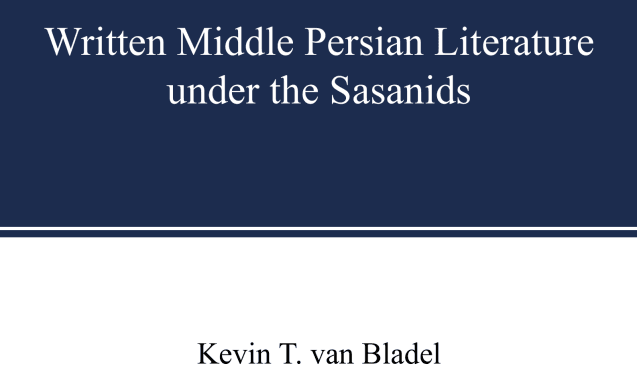
    Written Middle Persian Literature under the Sasanids

    van Bladel, Kevin T. 2024. Written Middle Persian literature under the Sasanids (AOS Essay 16). New Haven: AOS.

    Although there was oral literature among speakers of ancient Iranic languages, the author argues that there is no valid reason to assume that Middle Persian speakers, alone among sedentary peoples of their time, never or seldom wrote literary works in their language. Not only are there many Middle Persian literary works surviving in translation, and sufficient testimonies to the existence of Middle Persian literary works now lost and to Sasanian Middle Persian literacy, there are also strong explanations for their general nonsurvival that eliminate the assumption of a theory of predominant literary orality and disinclination to write literature, an argumentum ex silentio. We may reasonably assume that it is wrong to propose that what happens to survive in the original language on stone and metal surfaces and in desert environments represents the true range of Sasanian Middle Persian—the odds are far against it. Especially when propped up by a concept of “ancient Iranians” and without any definition of literature or the literary, it has no sound basis and is contradicted by a variety of extant sources.

  • War in the Ancient Iranian Empires

    Hyland, John O. & Khodadad Rezakhani (eds.). 2024. Brill’s companion to war in the ancient Iranian empires (Brill’s Companions to Classical Studies: Warfare in the Ancient Mediterranean World 9). Leiden: Brill.

    Brill’s Companion to War in the Ancient Iranian Empires examines military structures and methods from the Elamite period through the Achaemenid, Seleucid, Arsacid, and Sasanian empires. War played a critical role in Iranian state formation and dynastic transitions, imperial ideologies and administration, and relations with neighbouring states and peoples from Central Asia to the Mediterranean. Twenty chapters by leading experts offer fresh approaches to the study of ancient Iranian armies, strategy, diplomacy, and battlefield methods, and contextualise famous conflicts with Greek and Roman opponents.

    Table of Contents

    (more…)
  • African Individuals and Groups in Texts from Chaldean and Achaemenid Babylonia

    Karlsson, Mattias. 2024. From Memphis to Babylon: African individuals and groups in texts from Chaldean and Achaemenid Babylonia (Ägypten und Altes Testament 125). Münster: Zaphon.

    Die ersten Zivilisationen der Weltgeschichte, Ägypten und Mesopotamien, werden oft getrennt untersucht. Diese Studie verfolgt einen anderen Ansatz und konzentriert sich auf die Beziehungen zwischen diesen beiden Flusskulturen. Sie befasst sich mit der afrikanisch-babylonischen Interaktion im Zeitraum 626–331 v. Chr., als Babylonien (der heutige Südirak) zunächst das Zentrum eines Staates war, der den alten Nahen Osten dominierte, und dann eine wichtige Provinz im achämenidischen Reich. Während dieser 300 Jahre führten Auseinandersetzungen zwischen dem saitischen Ägypten (664–525) und dem chaldäischen Babylonien (626–539) sowie die persische Eroberung Ägyptens zu einem Macht- und Bevölkerungstransfer „von Memphis nach Babylon“. Das übergeordnete Ziel dieser Arbeit ist die Erörterung der Beziehungen zwischen Afrika und Mesopotamien. Die genaueren Ziele dieser Studie bestehen darin, Afrikaner (Ägypter, Kuschiten, Libyer) in babylonischen Texten aus der chaldäischen (626–539) und achämenidischen (539–331) Zeit zu identifizieren und die Anwesenheit von Afrikanern im chaldäischen und achämenidischen Babylonien zu erörtern unter dem Gesichtspunkt individuell-biografischer und kollektiv-demografischer Ebenen und Perspektiven. Die folgenden Forschungsfragen werden gestellt: Wer waren diese Afrikaner (in Bezug auf ethnische Zugehörigkeit, Geschlecht/Gender, Alter und Klasse)? Was haben diese Leute (beruflich) gemacht? Wann lebten sie (im Hinblick auf die Regierungszeit oder den Zeitraum)? Wo lebten sie (in Bezug auf Dorf, Stadt und Region)? Wie wurden sie in das babylonische Reich eingegliedert (zwangsweise/freiwillig, erste/zweite Generation usw.)? – Die Anwesenheit der afrikanischen Beamten im Dienste des chaldäischen und achämenidischen Babyloniens weist auf einen komplexen Prozess hin, in dem sowohl Anpassung als auch Kooptation eine Rolle spielten. Der Wunsch oder das Bedürfnis des Einzelnen, sich anzupassen, um zu überleben, co-existierte zusammen mit einem externen Druck von staatlicher Seite, der darauf abzielte, die afrikanischen Deportierten zu loyalen und profitablen Untertanen zu machen. Der Transfer von Memphis nach Babylon musste eine kontinuierliche Neubewertung dessen mit sich gebracht haben, was es bedeutete, ein Teil der ägyptischen Zivilisation an den Flüssen Babylons zu sein.

  • Mystical Landscapes

    Keshavarz, Fatemeh & Ahmet T. Karamustafa (eds.). 2024. Mystical landscapes in medieval Persian literature. Edinburgh: Edinburgh University Press.

    In this collection, Fatemeh Keshavarz and Ahmet T. Karamustafa bring together leading researchers from comparative literature, history, literary criticism and religious studies to explore the major authors and genres of medieval Persian mystical literature. Breaking out of the all-inclusive literary history framework, the contributors write on topics that have energised their scholarship over time and address areas where the literary and the mystical have mingled and led to paradigmatic creations. How can you interpret the climactic conclusion to the framing narrative of The Speech of the Birds of ‘Attar of Nishapur? How did ‘Aziz Nasafi understand the concept of religion? What do Rumi’s conversations with the Divine tell us about his teachings and his poetry? How do medieval Persian Sufi commentators add to our understanding the Qur’an? How can we utilise Sufi manuals, life stories and utterances? All of these explorations and more bring the depth and eloquence of Persian mystical literature to life in this volume.

    Editor note: This books falls outside our known comfort zone, but not by such a wide margin that we can ignore it. ~AZ

  • Zoroastrian Apocalypticism in The Maʿnī-yi Vahman Yasht

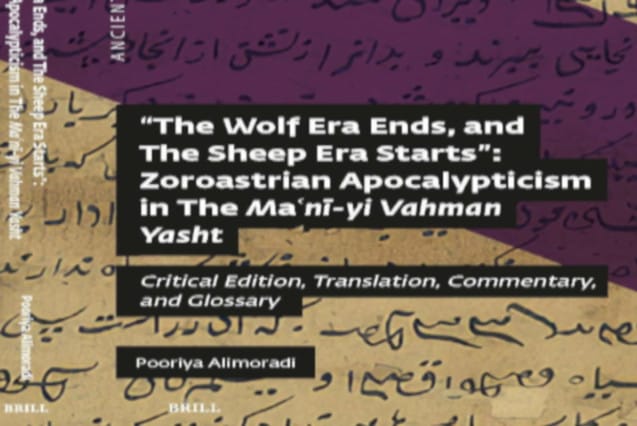
    Zoroastrian Apocalypticism in The Maʿnī-yi Vahman Yasht

    Alimoradi, Pooriya. 2024. “The wolf era ends, and the sheep era starts”: Zoroastrian apocalypticism in the Maʿnī-yi Vahman Yasht. Leiden: Brill.

    This book studies, for the first time, the Maʿnī-yi Vahman Yasht , the New Persian version of the Zand ī Wahman Yašt , the most important Zoroastrian text in apocalyptic genre. Through offering a critical edition, translation, and commentary, Alimoradi argues that the MVY is not a translation of the extant Pahlavi ZWY and is derived from another recension of apocalyptic materials in Pahlavi. He also offers suggestions in identifying several unspecified characters and events referred to in the text whose identities have been debated for decades. The book is relevant to those interested in Zoroastrianism, Iranian apocalyptic traditions, and anyone studying the Arab conquests in Western and Central Asia in 6ᵗʰ to 9ᵗʰ c. CE.