Author: Yazdan Safaee

  • Gold, Silver and Glass

    Gold, Silver and Glass

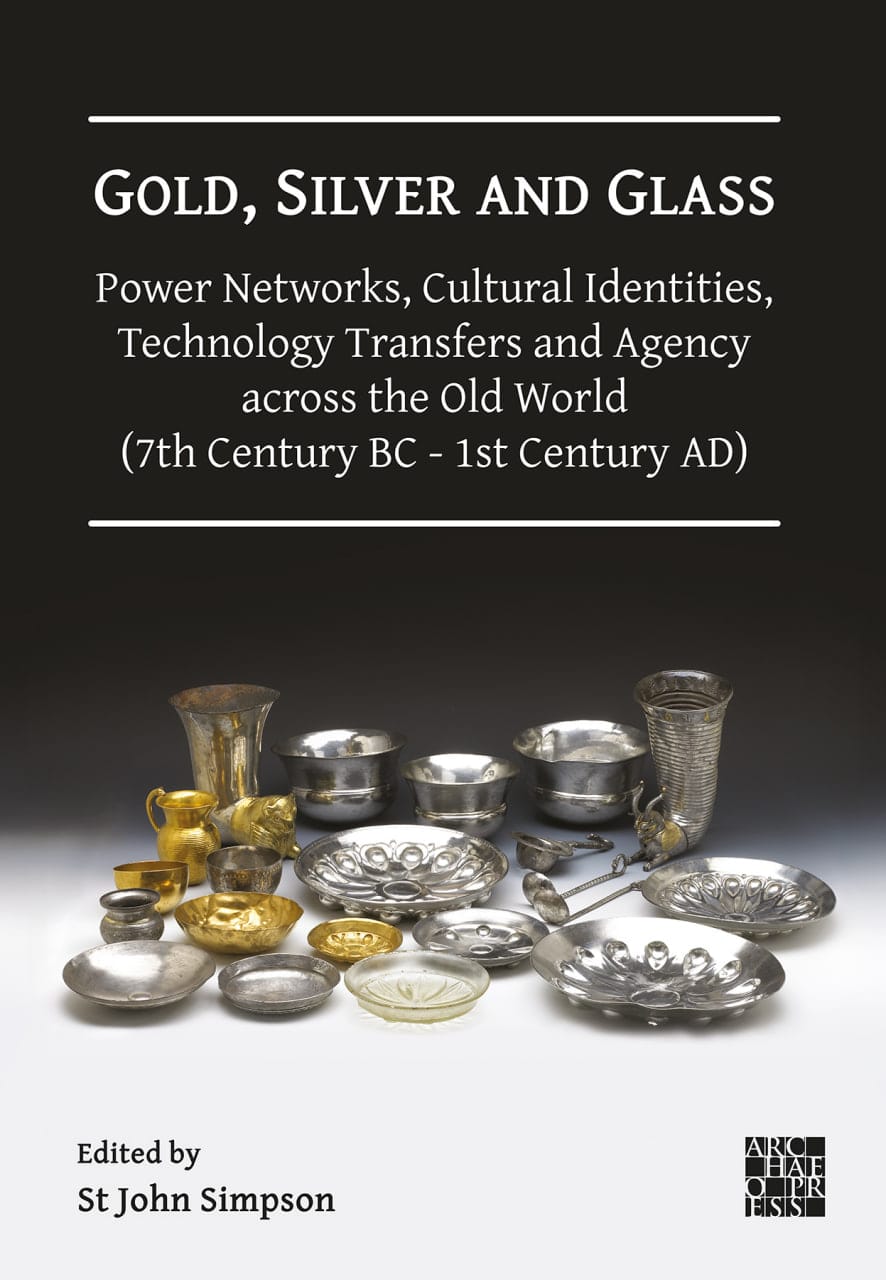
    Simpson, St John (ed.). 2026.Gold, silver and glass: Power networks, cultural identities, technology transfers and agency across the old world (7th century BC – 1st century AD). Bicester: Archaeopress.

    This volume explores how precious materials shaped power, identity and cultural exchange in the ancient world from the 7th century BC to early Roman times. Growing out of the British Museum special exhibition Luxury and Power: Persia to Greece, it brings together new perspectives on technology, value and artistic interaction from Greece to China.

    (more…)
  • Herodotus on the Expedition of Datis and Artaphrenes

    Degen, Julian. 2025. Herodotus on the Expedition of Datis and Artaphrenes: Athenian Imperialism Mirrored in the First Persian War. The Classical Quarterly, FirstView. 1–14.

    By accepting a later dating for the composition of the Histories, this article argues that Herodotus mirrors Athenian imperialism in his account of the First Persian War to convey a political message to contemporary recipients. In doing so, he departs from the prevailing tradition of the expedition of Datis and Artaphrenes by creating a narrative that manipulates Persian methods of conquest, presenting them in a manner that appears emblematic of Athenian imperialism. In this way, the Herodotean Persians do not adhere to their expected cultural script, but act out the Athenian script. This reading offers a new understanding of Herodotus’ account of the Persian campaign as conveying a message to the Athenians who began to recognize that their former policies toward their allies were transgressive imperialism. As a result, his account of the First Persian War is a sophisticated meditation on the effects of imperialism rather than a straightforward depiction of historical events.

  • Debating Cyrus

    Debating Cyrus

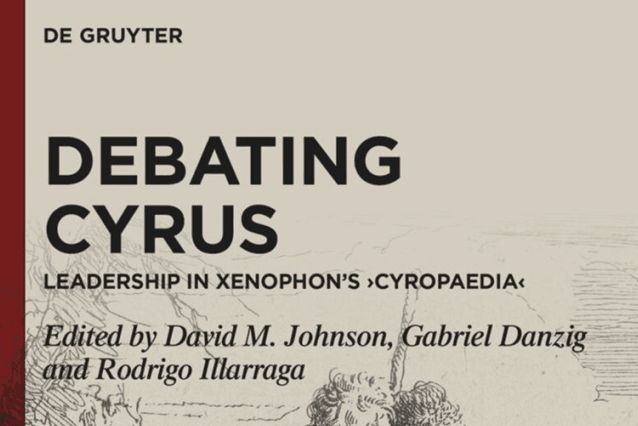
    Johnson, David M., Gabriel Alexander Danzig and Rodrigo Illarraga (eds.). 2026. Debating Cyrus: Leadership in Xenophon’s ›Cyropaedia‹ (Xenophon Studies 2). Berlin: De Gruyter.

    Is Xenophon’s Cyrus the Great the model leader he seems to be, or does his apparent success actually demonstrate the dangers of imperialism and one-man rule?

    Debating Cyrus gathers contributions from many of the world’s leading scholars in Xenophontic Studies, and features scholars with a wide range of approaches to reading classical texts. Our essays discuss the surprisingly subtle techniques Xenophon employs, and study topics including ambition, the rule of law, hunting, tragedy, romance, and the use Cyrus makes of love and fear. A cluster of essays considers Cyrus’ one apparent failure — the failure to ensure his kingdom will prosper after him. Other essays show what we can learn about the Cyropaedia by comparing it to other works by Xenophon and his contemporaries.

    Our aim is not to resolve the debate about Cyrus, a debate that will live on as long as readers care about Xenophon’s magisterial account of the founder of the greatest empire of his day and disagree about what sort of leadership to expect from a leader like Cyrus. Our goal is to prepare readers to engage in the debate themselves.

  • Herodotus and Women

    Herodotus and Women

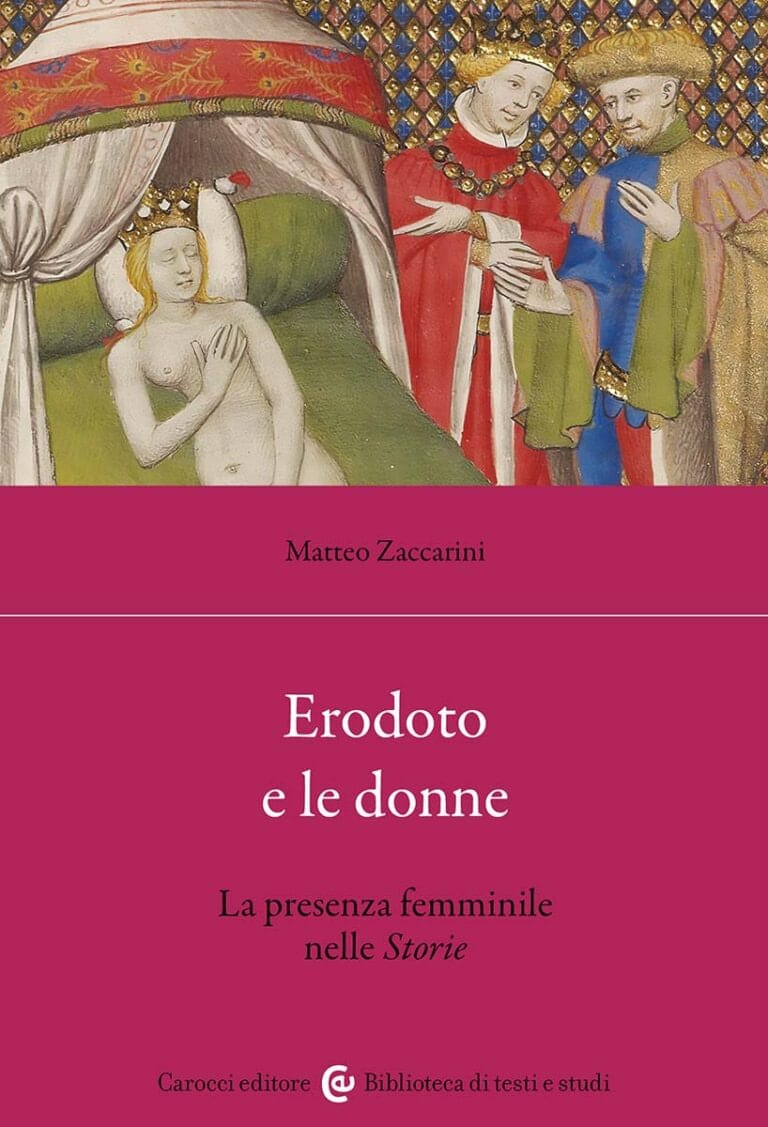
    Zaccarini, Matteo. 2024. Erodoto e le donne: La presenza femminile nelle Storie. Rome: Carocci.

    Elena partì da Sparta con i Troiani, ma, forse, fu una fuga volontaria più che un rapimento. La regina di Lidia, disonorata dal marito, congegnò una vendetta esemplare e teatrale. L’etera Rodopi, in origine una schiava, divenne una figura leggendaria grazie alla fama e a un monumento eccezionali. L’uomo più potente al mondo, il Gran Re persiano Serse, rischiò la rovina per via della rivalità tra donne di corte. In Grecia i Persiani furono sconfitti, ma la straordinaria Artemisia, unica donna tra le loro fila, uscì vincitrice su tutti. A guardar bene poi, la vittoria dei Greci fu dovuta anche a una bambina prodigio, Gorgo. E così via. Attraverso figure femminili ordinarie o eccezionali, le Storie di Erodoto indagano gli aspetti più profondi della natura umana, costruiscono un universo complesso e sfaccettato, insinuano il dubbio sul senso delle grandi guerre e sulle gesta dei grandi uomini. Di volta in volta con sottigliezza, ironia, tragica consapevolezza e incredibile modernità. Prima monografia sul tema, il volume analizza la narrazione del “padre della Storia” sul femminile e ripensa gli stereotipi sulla misoginia degli antichi Greci.

  • Dabir (vol. 12)

    Dabir (vol. 12)

    Volume 12 of Dabir (2025) is now available both online and in print, featuring two issues:

    • Salman Aliyari Babolghani: The Imperfect with the t-Type Prefix in New Iranian and Its Connection to the Old Iranian Augmented Imperfect Optative
    • Majid Daneshgar: Reading Ismāʿīlī Islam in Aceh: Shāh Shams Sabziwārī’s Poems Copied in the 15th-Century Indonesia
    • Meysam Mohammadi: Middle Persian, Early New Persian and Fahlawī Quotations in Tārīx-e Qom
    • Salman Aliyari Babolghani: The Verb ‘to Become’ and Its Significance in Western Iranian Historical Dialectology: the Case of Persian and Lori
    • Majid Daneshgar: An Unknown Malay-Javanese Booklet Belonging to Thomas Erpenius: Early Days of the Shaṭṭārī Prayers in Indonesia
    • Pouria Shokri and Ahmad Salehi Kakhki: The Morphology and Classification of Tiles from the Ilkhanid Era until the Timurid Invasion, with Emphasis on Techniques, Forms, and Glazes
    • Hossein Sheikh: Review of Zamāna wa Zindagi-ye wa Kārnāma-ye Mollā Huseyin Wāˁiz-i Kāšifi, written by Mostafa Gohari-ye Fakhrabad
    • Sun Wujun[孫 武軍] and Chen Fan[陳 帆]: Review of Zhonggu Xianjiao Dongchuan Jiqi Huahua Yanjiu 中古祆教東傳及其華化研究 [Studies on the Spread of Zoroastrianism in Medieval China], written by Zhang, Xiaogui [張小貴]
  • Anabasis, vols. 14-15

    Anabasis, vols. 14-15

    Volumes 14-15 (2023-2024) of Anabasis. Studia Classica et Orientalia, edited by Marek Jan Olbrycht, is out now. Several papers and reviews of the issue relate to ancient Iran:

    • Michał Podrazik: Cyrus the Younger in Syria and Mesopotamia, Abrokomas, and the Great King’s Defensive Strategy (401 BC)
    • Heckel: Alexander and the Amazon Queen
    • Harry Falk: Zariaspa and the “Kunduz” Hoards
    • Karlheinz Kessler: More about Nwt/Nōd and Adiabene
    • Andreas Luther: Artabanos und die Meder
    • Marek Jan Olbrycht: Parthian Weapons and Military Equipment: Some Remarks
    • Review Articles / Reviews:
    • Marek Jan Olbrycht: Recent Perspectives on Parthian History: Research Approaches and Methodological Concerns
    • Jeffrey D. Lerner: Seleucid History: New Perspectives and Current Challenges
    • Sabine Müller: [Review of] Marek Jan Olbrycht, Early Arsakid Parthia (ca. 250-165 B.C.) At the Crossroads of Iranian, Hellenistic, and Central Asian History, Leiden / Boston: Brill 2021 (Mnemosyne Supplements 440)
    • Lang Xu: [Review of] Juping Yang (ed.), Ancient Civilizations and the Silk Road, Beijing: China Social Science Press, 2021
  • The Late Babylonian worship scene at Persepolis

    Garrison, Mark B. 2025. The Late Babylonian worship scene at Persepolis. In: Benjamin Sass & Laura Battini (eds.), Mortals, Deities and Divine Symbols: Rethinking Ancient Images from the Levant to Mesopotamia. Studies Offered to Tallay Ornan (Archaeopress Ancient Near Eastern Archaeology 12), 477-536. Bicester: Archaeopress.

    This analysis concerns several types of worship scenes found in the glyptic imagery preserved as impressions on clay administrative tablets from Persepolis. This important body of data is known today as the Persepolis Fortification Archive, dating to the middle-late years of the reign of Darius I (ruled 522/521–486 BCE). The principal scene, a worshipper who stands before divine symbols that rest on pillared pedestals, here called the Late Babylonian worship scene, is well-known, often characterized as the most distinctive of the glyptic landscape in the Late Babylonian period. At Persepolis, the Late Babylonian worship scene occurs on a large number of seals and exhibits a rich iconographic repertoire; indeed, the evidence from Persepolis is as numerous and varied as from any Babylonian archive. The seals from Persepolis raise numerous issues regarding the chronology and iconographic and stylistic development of the scene in the Late Babylonian archives. These Persepolitan seals present a particularly interesting case study in the complexities of cultural interaction between Iran and Babylonia in the middle of the 1st millennium BCE.


  • Reaching the Persian Gulf from the Kur River Basin

    Matin, Emad. 2025. Reaching the Persian Gulf from the Kur River Basin: Patterns of an Intermittent Connectivity. East and West 65 (1).

    The paper at hand explores the connectivity between Central Fars and the Persian Gulf over a long period of time from protohistory to the Early Islamic era. In doing so, it focuses on the three areas of the Kur River Basin, Dashtestan and the Bushehr Peninsula and reviews the rise and fall of settlements in these areas—within the limits of the existing bibliography. The paper thus demonstrates that these areas, i.e. the Highland, the Hinterland and the Coastline, had played a significant role in the aforesaid communication network for centuries. Furthermore, the pattern of this connectivity is reconstructed using archaeological and historical sources. The most innovative conclusion put forth is that for the first time it is possible to confirm the existence of intermittent connectivity with a very similar pattern among these areas, especially in the Elamite, Achaemenid and Sasanian eras.

  • Studies on Middle Babylonian texts from Haft-Tappe

    Studies on Middle Babylonian texts from Haft-Tappe

    Nikkhah Bahrami, Gita. 2025. Untersuchungen zu mittelbabylonischen Texten aus Haft-Tappe (dubsar 27). Münster: Zaphon.

    G. Nikkhah Bahrami’s study offers a comprehensive edition and cultural-historical and economic-historical investigation of the texts in Middle-Babylonian Akkadian found at Haft-Tappe in the province Khuzestan in southwestern Iran. Following a brief introduction (I.), paleography, syllabary, orthography, and other philological questions concerning the texts are discussed (II.). The third section (III. historical aspects) addresses the question of identifying Haft-Tappe with Kabnak, as well as questions related to the rulers documented at Haft-Tappe and their building activities. After discussing place names and terrain features (IV.), religious and cultic aspects (V.), the legal questions of those texts containing terminology reminiscent of legal contexts are examined (VI.). An overview of social aspects (VII.) addresses the titles of officials, occupational names, and the role of women in the texts from Haft-Tappe; another section examines administrative terminology, data formulas, and the names of administrative departments (VIII.). Following the overview of the various materials that are the focus of each text (IX.), the administrative texts are arranged in the edition (Part B) according to the following categories: metal, stone and glass, reed and wood, mineral substances, textiles, shoes, animal husbandry, foodstuffs, labor, and labor; followed by editions of “Stone Inscription III” and fragmentary texts. Extensive indexes of names and occupational titles, as well as a list of the specifically attested sign forms, supplement the monograph.

  • Persia’s Greek Campaigns: Kingship, War, and Spectacle on the Achaemenid Frontier

    Persia’s Greek Campaigns: Kingship, War, and Spectacle on the Achaemenid Frontier

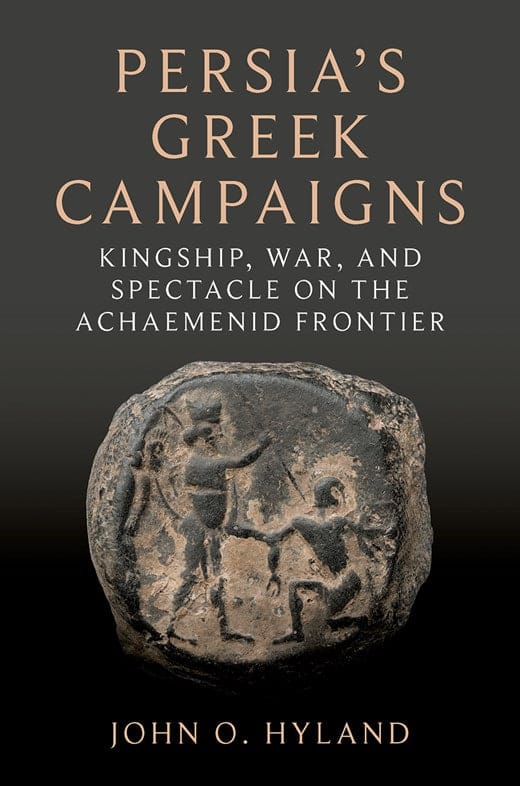
    Hyland, John O. 2025. Persia’s Greek campaigns: Kingship, war, and spectacle on the Achaemenid frontier. Oxford: Oxford University Press.

    Persia’s Greek Campaigns offers a bold reassessment of the wars between the Achaemenid Persian kings and the Greek city-states (c. 499–449 bce). These conflicts, and especially Xerxes’s invasion of Greece (480–479 bce), are remembered as foundational events in Greek history, but the “Persian version” remains neglected. The Persians left no campaign narratives to compare with the Greek accounts of Herodotus and Aeschylus—but their documents, artwork, and artifacts offer the foundations for a new interpretive study. Achaemenid royal inscriptions, seals and documents from Persepolis, and texts from earlier Near Eastern empires illuminate Persian worldviews and approaches to frontier warfare. Persia’s Greek campaigns did not emerge from policies of infinite expansion or “East-West” struggle, but drew on a long tradition of Near Eastern royal display through expeditions to distant frontiers. Such campaigns advertised a king’s heroic credentials, possession of divine favor, and achievement of universal power. Xerxes’s journey from Iran to Athens marked the pinnacle of this tradition, combining ideological spectacles with masterful logistical preparation. It achieved its principal goals through the seizure and burning of Athens, but its unexpected and embarrassing defeats at Salamis and Plataea undermined the intended image of royal grandeur. The resulting transition to an era of diplomatic consolidation marked a vital step in the evolution of history’s first “world empire.”