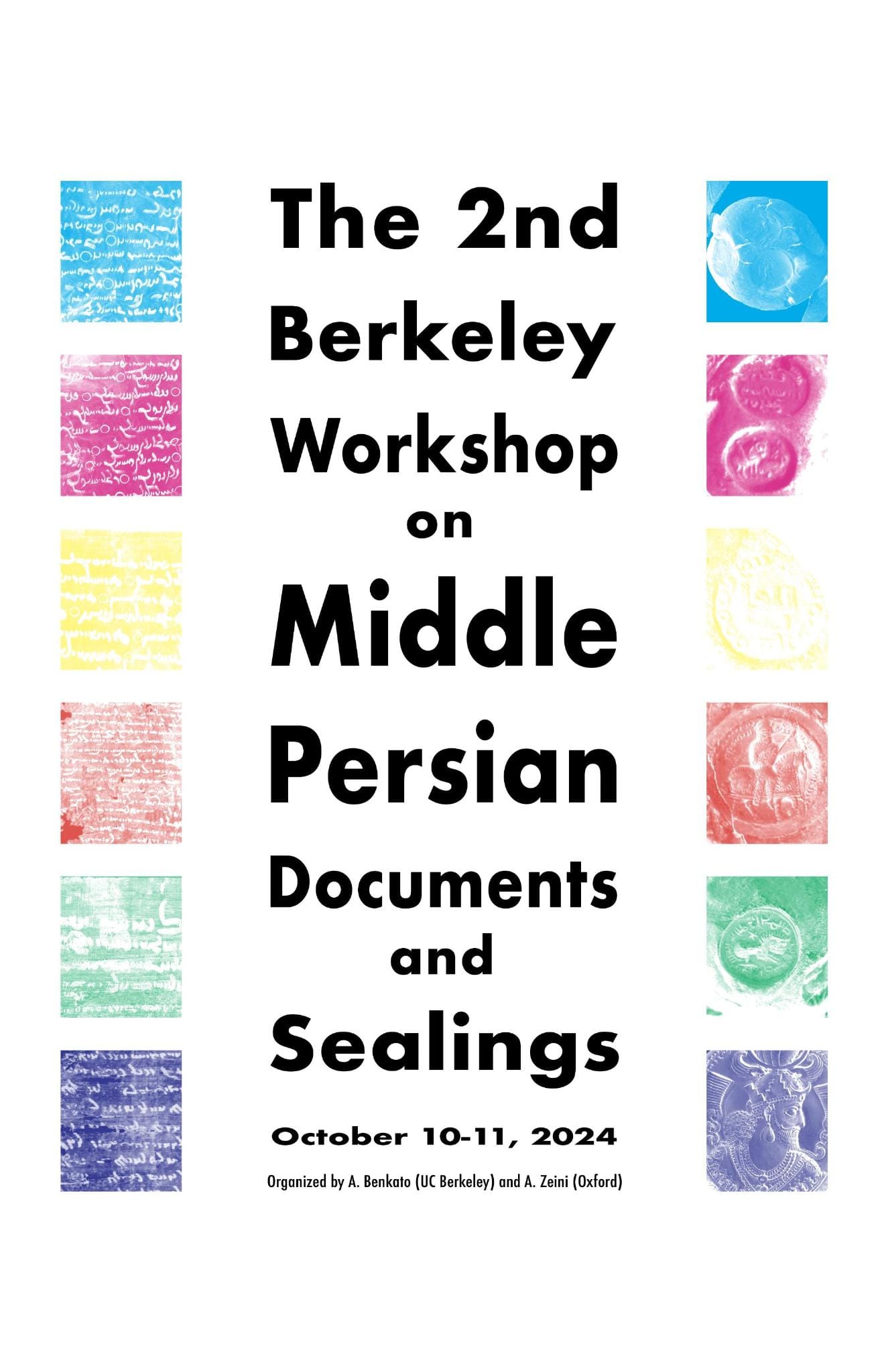
The 2nd Berkeley Workshop on Middle Persian Documents and Sealings
This is the second workshop in a series that began in Spring 2023 with the idea of bringing together scholars around the world who were actively working on, or interested in working on Middle Persian documents and sealings. The workshop is organised by Adam Benkato (UC Berkeley) and Arash Zeini (University of Oxford).
To attend the workshop, which takes place on Zoom, register here. The programme is below.
Gorani refers to under-documented, endangered varieties spoken in a cluster within the Zagros mountains (Iran/Iraq). These varieties possess conservative features of importance to linguists. However, their study has been plagued by nomenclature and taxonomy issues. Traditional names for these languages have been supplanted first by orientalists’ prescriptions and then by their linguist heirs. Inaccurate terminology has sewn discord between speaker communities, disturbing the sociolinguistic landscape. This volume represents the state of the art of Gorani’s historical and socio-linguistics, documentation, and literature, as well as an effort to aid the “decolonization” of Gorani linguistics.
This lecture offers an exploration of the complex history of the Zoroastrian community in Ahvaz, a city in the province of Khuzestan in Iran. Because of economic hardship and agricultural decline in Yazd, Zoroastrians started migrating there in the early 20th century. Earlier censuses from the 19th century, such as those by Hataria in 1854 and Houtum-Schindler in 1882, record no Zoroastrian presence in Ahvaz. The earliest mention of Zoroastrians in the city appears in the 1963 census, which was prepared for the National Zoroastrian Congress held in Kerman that same year. The Zoroastrian community in Ahvaz has so far found little, if any scholarly attention due to the dearth of documentation. However, as a result of new archival evidence from the Pouladi Collection, unearthed by the speakers in 2016, new data has emerged that throws light on the reasons for the migration from Yazd to Ahvaz. The new documents provide evidence that Zoroastrian settlements were established in the 1920s along the Karun River through the agricultural enterprise, the Mazdyasnān Company. This lecture examines how the Zoroastrian community of Ahvaz flourished in their new home, contributing to the prosperity of the region, but later, despite its successes, gradually declined. This development raises critical questions regarding the preservation of minority heritage in Iran.
‘A Spark of the Glimmer of the Original Light’: A Workshop on the Dēnkard as Literature, Theology, and Scholasticism 17-18 Oct, Wolfson College University of Oxford
Professor Samra Azarnouche (L’École Pratique des Hautes Études – Paris Sciences & Lettres) and Yuhan Sohrab-Dinshaw Vevaina will be co-convening a workshop on the Dēnkard. Co-sponsored by EPHE, Paris and AMES, University of Oxford, this two-day Workshop on literature, theology, and scholasticism of the Zoroastrian community in the 9th century CE, is to be held on Thursday and Friday, 17–18 October 2024 in the Buttery at Wolfson College.
The Dēnkard, the towering achievement of Zoroastrian scholasticism in Late Antiquity and compiled in the 9th century CE, serves as a comprehensive compendium of Zoroastrian beliefs, practices, and doctrines. In its nine books, the Dēnkard, at 169,000 words, covers a staggering range of topics, including cosmology, ethics, rituals, jurisprudence, and the history of Zoroastrianism and its textual transmission. The work addresses various theological questions, offering explanations for the nature of good and evil, the existence of the spiritual world, and the role of humanity in the cosmic struggle between Ohrmazd, the god of light and order, and Ahrimen, the principle of darkness and chaos. Through its challenging rhetorical structures and hermeneutical interpretations, the Dēnkard provides unique insight into the dualistic Zoroastrian world-view and its influence on ancient and medieval Iranian society. As a crucial source of Zoroastrian thought and tradition, the Dēnkard not only informs contemporary practitioners but also scholars and researchers interested in the history of religion, Iranian studies, and comparative theology. Its significance lies in its preservation of Zoroastrian theology and its role in shaping the religious and cultural landscape of the pre-Islamic Iranian world.
The Workshop will be conducted based on pre-circulated papers which will explore the nature and character of a particular book of the Dēnkard, structural and intertextual connections between different books, and the broader questions of transmission and historical context. The workshop will feature a variety of distinguished scholars from the UK, continental Europe, and North America working on Zoroastrianism in Late Antiquity and the early Islamic period.
Azarnouche, Samra. 2024. Tectonique des mythes. Croyances et théories zoroastriennes sur le tremblement de terre. Revue de l’histoire des religions 241(2). 275–297.
Anselm Kiefer, Le Croissant fertile, 2010
While the earthquake is primarily a cosmogonic act provoked by the intrusion of Evil into Ohrmazd’s world, the Zoroastrian accounts describing the phenomenon also bear witness to a striking confluence of myth, mechanistic theories and biological analogies. The tradition conveyed by the texts (Bundahišn 21e, Dēnkard III.93 and Dādestān ī Dēnīg 69) attributes the earthquake sometimes to the demon Čišmag and his atmospheric acolytes, sometimes to the sorcerer Frāsyāb, two figures who also have in common that they are associated with drought. Some episodes featuring them also include a mysterious appearance by Spandarmad, the Earth goddess. These elements indicate that the Zoroastrian aetiology of earthquakes was far more narratively complex than the texts handed down to us give us to understand.
Abstract
The above article is part of an issue dedicated to earthquakes: